Content Library & AI generation
The Content Library stores reusable assets and source material — product descriptions, brand guidelines, prior campaign copy. Each source is indexed for retrieval, so Content Generate can pull the most relevant passages into an AI draft instead of writing from a blank context.
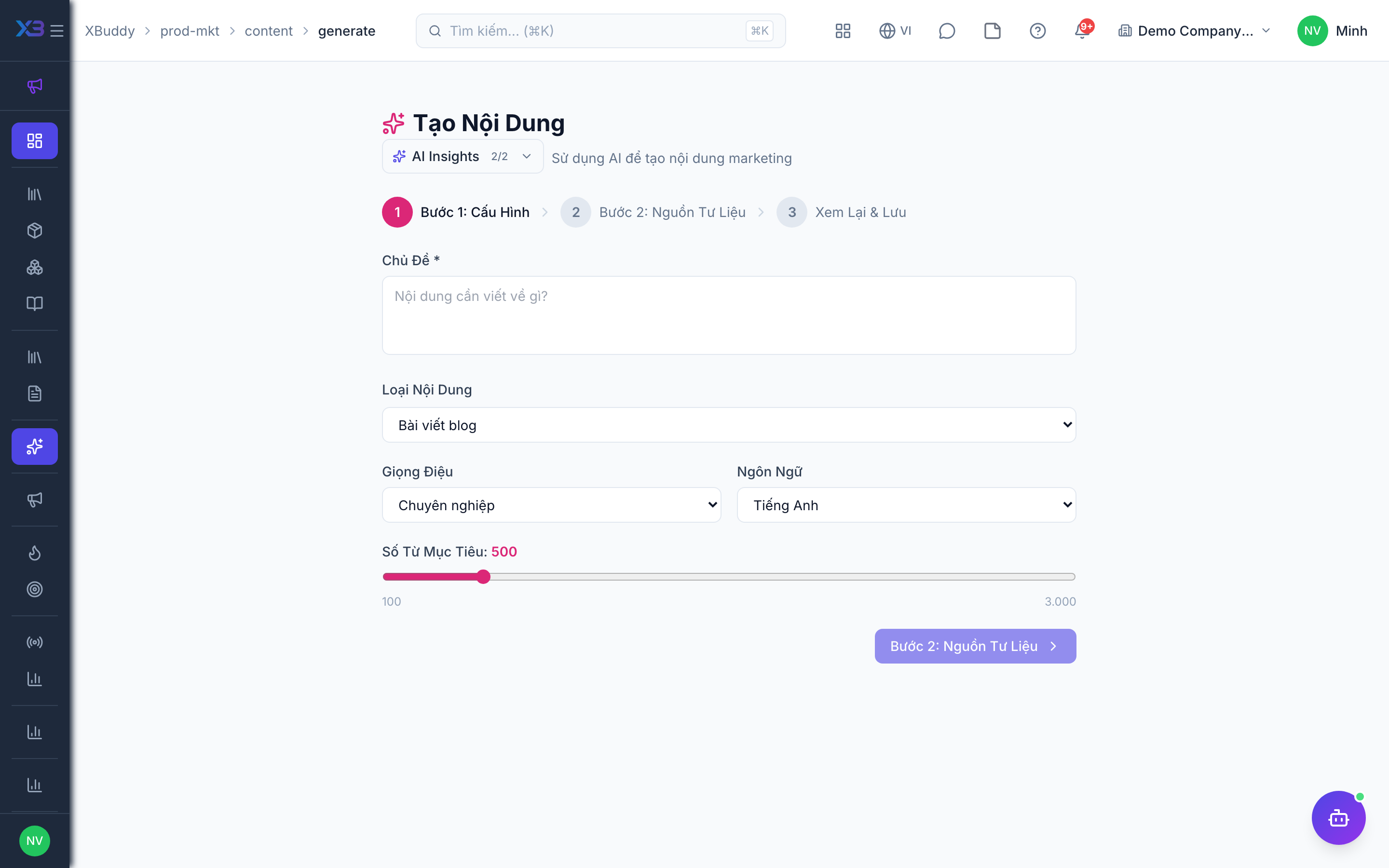
How it works: when you generate a piece, the AI first searches your library sources for the most relevant passages — either across the whole library, or scoped to the specific sources you select — and feeds that context, along with your topic, content type, tone, and target word count, into the draft. You review and edit before saving; nothing is published automatically. A saved draft becomes a Content Piece that moves through its own review lifecycle (draft → review → published → archived) and can be attached to a campaign or exported. From a library source’s detail view, “Generate from this source” jumps straight into Content Generate with that source pre-selected.
When to use
Use this when you need marketing copy that follows your own product facts and tone, or when you want to keep reusable source material in one searchable place.
Before you start
- Permissions:
content:readto open the Content Library, Content Pieces, and Generate pages;content:writeto add sources, generate, save, or export a piece to Documents. - AI quota: generation uses the AI Gateway, so it can be limited by your plan’s AI usage.
- Toggles: there is no dedicated toggle for this page. The content assistant only drafts; nothing is published automatically.
Step by step
Organize source material
Go to Product & Marketing -> Content Library (/prod-mkt/content/library) and add reference assets: product descriptions, brand guidelines, prior campaigns. Sources are indexed automatically so they can be retrieved during generation.
Generate a piece
Open Product & Marketing -> Content Generate (/prod-mkt/content/generate), pick a content type (blog post, email, social post, etc.), describe the topic (e.g. “launch email for the Pro plan”), optionally select which library sources to ground the draft in, and set a tone, language, and target length. The AI drafts from that context.
Review and edit the draft
Read the draft, check facts and claims against your source, and adjust as needed. Nothing is saved until you save it.
Save and move it through review
Save the draft. It becomes a Content Piece (/prod-mkt/content/pieces) in draft status. Move it to review, then mark it published when it is approved for use.
Attach or export
Link the published piece to a campaign, or export it to Documents so the team can share it.
Statuses
| Status | Meaning | Next |
|---|---|---|
draft | Newly saved piece, still editable. | review |
review | Waiting for a second pair of eyes. | published |
published | Approved for use; can be attached to a campaign or exported. | archived |
archived | Retired without deleting the record. | - |
Tips & common mistakes
- Add real product facts and brand guidelines to the library first; an empty library gives generic drafts.
- Select specific sources when the topic is narrow (for example one product launch) so the AI does not pull unrelated passages.
- Always review the draft: the AI suggests, you approve.
- Use “Generate from this source” on a library source to jump to Generate with that source pre-selected.
- Do not treat a
draftpiece as ready to send; onlypublishedpieces should be attached to campaigns.
Related